Research themes
Planet formation and atmospheres
My group studies how planets grow, how they rotate, and how their atmospheres change. We use Hubble, JWST, and ground-based telescopes to measure accretion, compare day- and nightside spectra, and separate faint planets from their host stars.
Our research
Three connected questions guide our observations and the methods we develop.
01 · Formation
How young planets grow
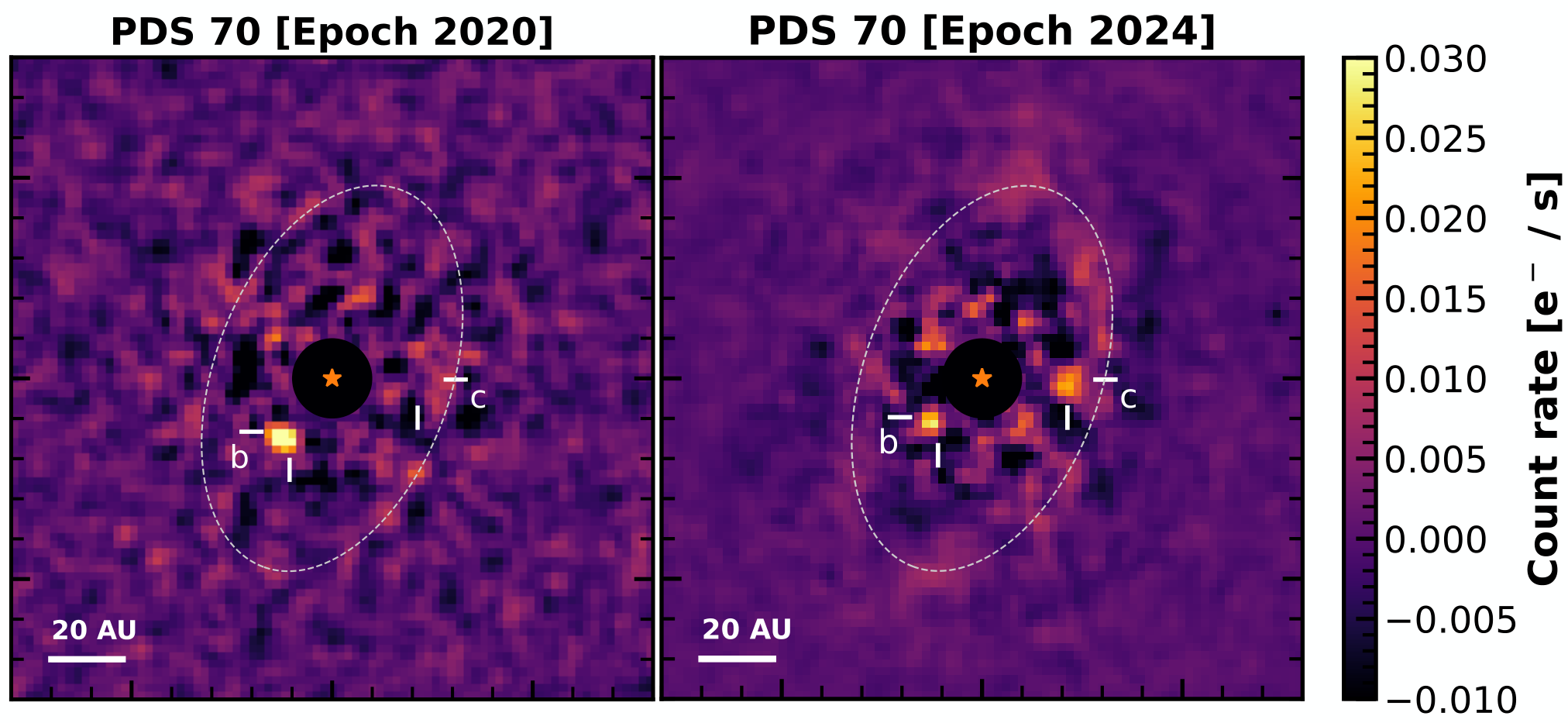
Is gas accretion steady or variable? We measure the light released as gas falls onto young planets. PDS 70 c's changing hydrogen emission shows why repeated observations matter.
Explore the formation work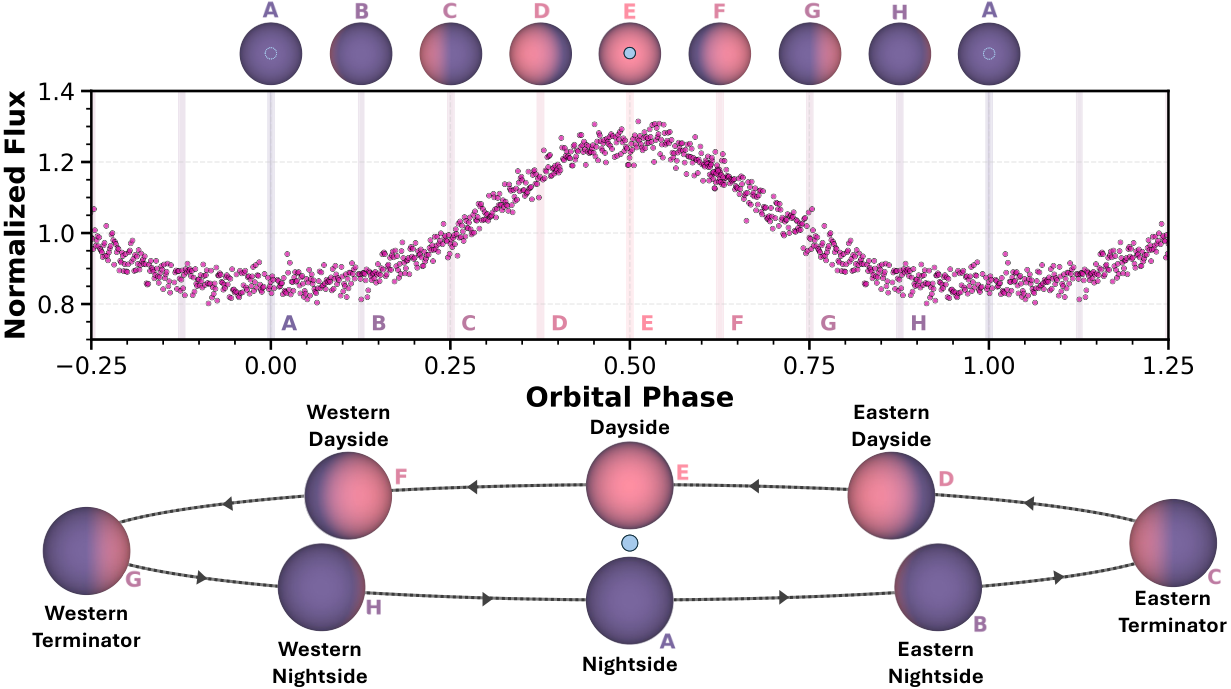
02 · Atmospheres
Irradiated brown dwarfs
How much heat moves from day to night? Daphne Broski-Laing's JWST study of ZTF0038B measures inefficient heat transport and a nightside carbon dioxide feature that remains difficult to explain.
Explore irradiated worlds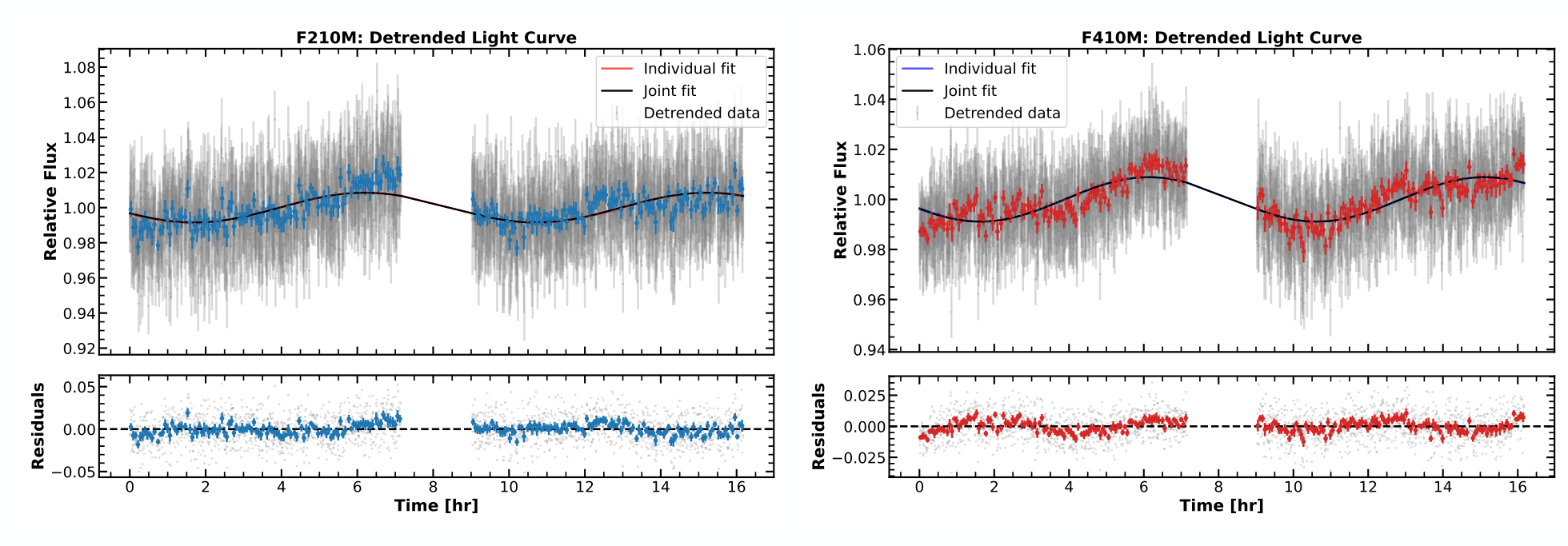
03 · Imaging and variability
Finding planets and measuring their changes
What can repeated images and spectra reveal? Our recent work measures β Pictoris b's rotation, searches MIRI images for outer planets, and tests cloud models with changing brown-dwarf spectra.
Explore imaging and variabilityRecent results
What we measured, what it tells us, and the questions that remain. Each article links to the research paper and its original figures.
Zhou et al. · September 2026
Measuring a nine-hour day on β Pictoris b
Two infrared light curves give a 9.00 ± 0.13-hour rotation period. The quoted error is statistical; atmospheric evolution adds uncertainty. The combined measurements favor an equator-on view without determining the full three-dimensional obliquity.
Read the Deep Dive: Measuring a nine-hour day on β Pictoris bLi et al. · July 2026
Searching existing JWST images for cold giant planets
Archival MIRI images of ten M-dwarf systems constrain the brightness of possible outer companions. The study reports detection limits, not confirmed new planets; inferred mass limits depend on age and atmospheric models.
Read the Deep Dive: Searching existing JWST images for cold giant planetsBroski-Laing et al. · June 2026
Day and night on a brown dwarf beside a white dwarf
JWST spectra across a full orbit show inefficient day-to-night heat transport on ZTF0038B. An asymmetric nightside carbon dioxide feature remains unexplained, while nightside emission constrains the system's evolutionary history.
Read the Deep Dive: Day and night on a brown dwarf beside a white dwarfChapleski & Zhou · February 2026
When brown dwarfs change brightness without much change in color
Three brown dwarfs show less change in variability amplitude across the water absorption band than a well-studied comparison object. Their different brightness-color trends test how clouds and temperature affect the spectrum.
Read the Deep Dive: When brown dwarfs change brightness without much change in colorAdams et al. · November 2025
Following a young planet's changing spectrum with JWST
A 12.56-hour sequence follows spectral changes in both 2M1207 A and b. The companion's variability is broadly consistent with changing cloud coverage, but the observations do not establish a full rotation period.
Read the Deep Dive: Following a young planet's changing spectrum with JWSTZhou et al. · February 2025
PDS 70 c: a growing planet changes brightness
PDS 70 c's hydrogen-alpha emission increased significantly between the 2020 and 2024 Hubble observations. The changing accretion signature affects when a growing planet can be detected.
Read the Deep Dive: PDS 70 c: a growing planet changes brightnessOur approach
What can variability tell us?
Changes in brightness and spectra constrain processes that a single observation cannot measure. We compare these changes with models of accretion, clouds, chemistry, and heat transport.
Deep Dive explains the observations and results behind our recent papers.
Student projects
Students measure brightness changes, extract spectra, test how well faint sources can be recovered, and compare observations with physical models. Yihan's MIRI search and Maddie's Hubble study are recent examples.
I welcome inquiries from students interested in these questions. Visit the prospective-student section for preparation and how to get in touch.