Research theme 03 · Time-domain methods
JWST time-domain imaging and spectroscopy
Repeated images and spectra let us measure planetary rotation, test cloud models, and search for faint companions. We develop methods that separate these signals from changes in the instrument and the host's light.
The question
Which faint planets can we detect, and what do changes in their brightness and spectra reveal about rotation and atmospheric structure?
What we observe
We monitor directly imaged planets with NIRCam and NIRSpec, and use long MIRI observing sequences to search for outer companions. Hubble spectra of brown dwarfs provide a comparison sample for testing atmospheric models without a bright host star nearby.
What we have learned
Our 2026 NIRCam study measures a 9.00 ± 0.13-hour rotation period for β Pictoris b. This is the formal sinusoidal-fit uncertainty; atmospheric evolution can broaden it. The combined rotation constraints favor an equator-on view, but do not determine the full three-dimensional obliquity. Read the β Pic b Deep Dive.
Yihan Li's MIRI study uses archival images of ten M-dwarf systems to search for distant planets and measure detection limits. Read about the MIRI search.
Madalyn Chapleski's Hubble study compares spectral variability in three brown dwarfs with a well-studied benchmark. The different brightness-color trends test models of clouds and temperature. Read about the brown-dwarf spectra.
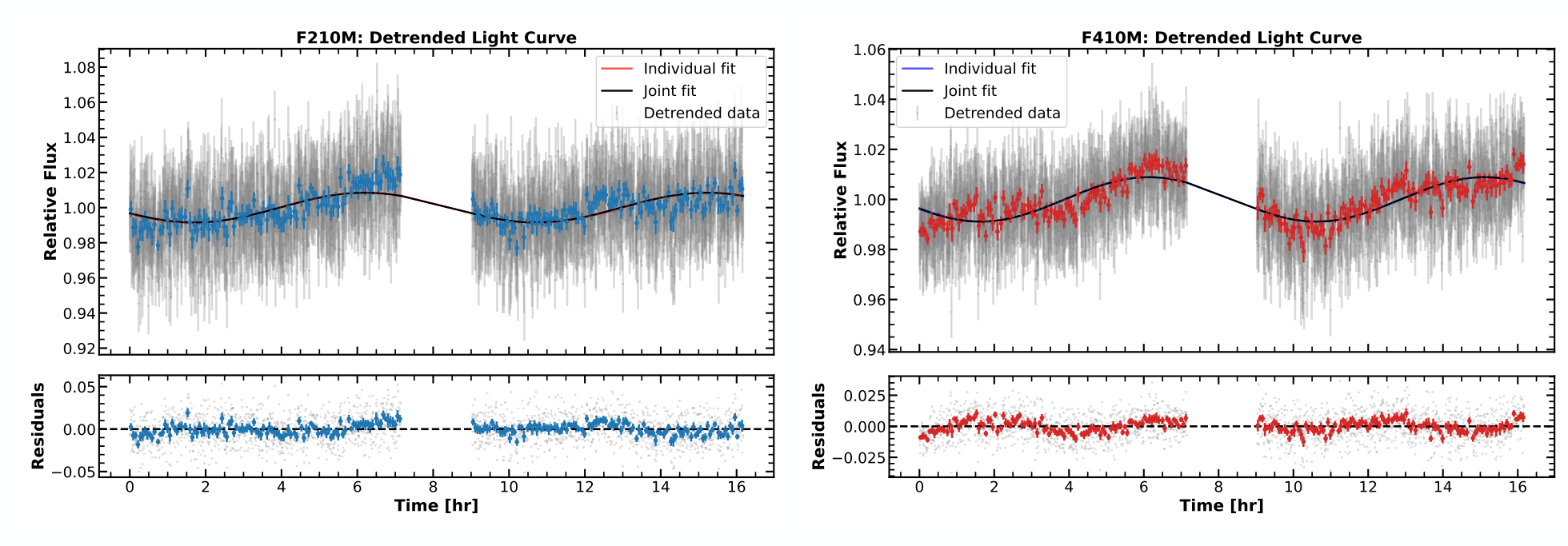
Adams et al. (2025) measured spectral changes in 2M1207 A and b over 12.56 hours with JWST. The companion's variability is broadly consistent with changes in the visible coverage of clouds. Read the Deep Dive or the paper on ADS.
Why it matters
Time series constrain rotation and test whether an atmospheric model explains both the average spectrum and its changes. Searches in the same kinds of imaging data also constrain which outer planets may accompany known inner systems.
Opportunities for students
Students can align images, model starlight, extract spectra, measure variability, and test detection limits with injected sources. Yihan's MIRI search and Maddie's Hubble study show how these projects connect data analysis with physical questions.