Looking beyond the known planets
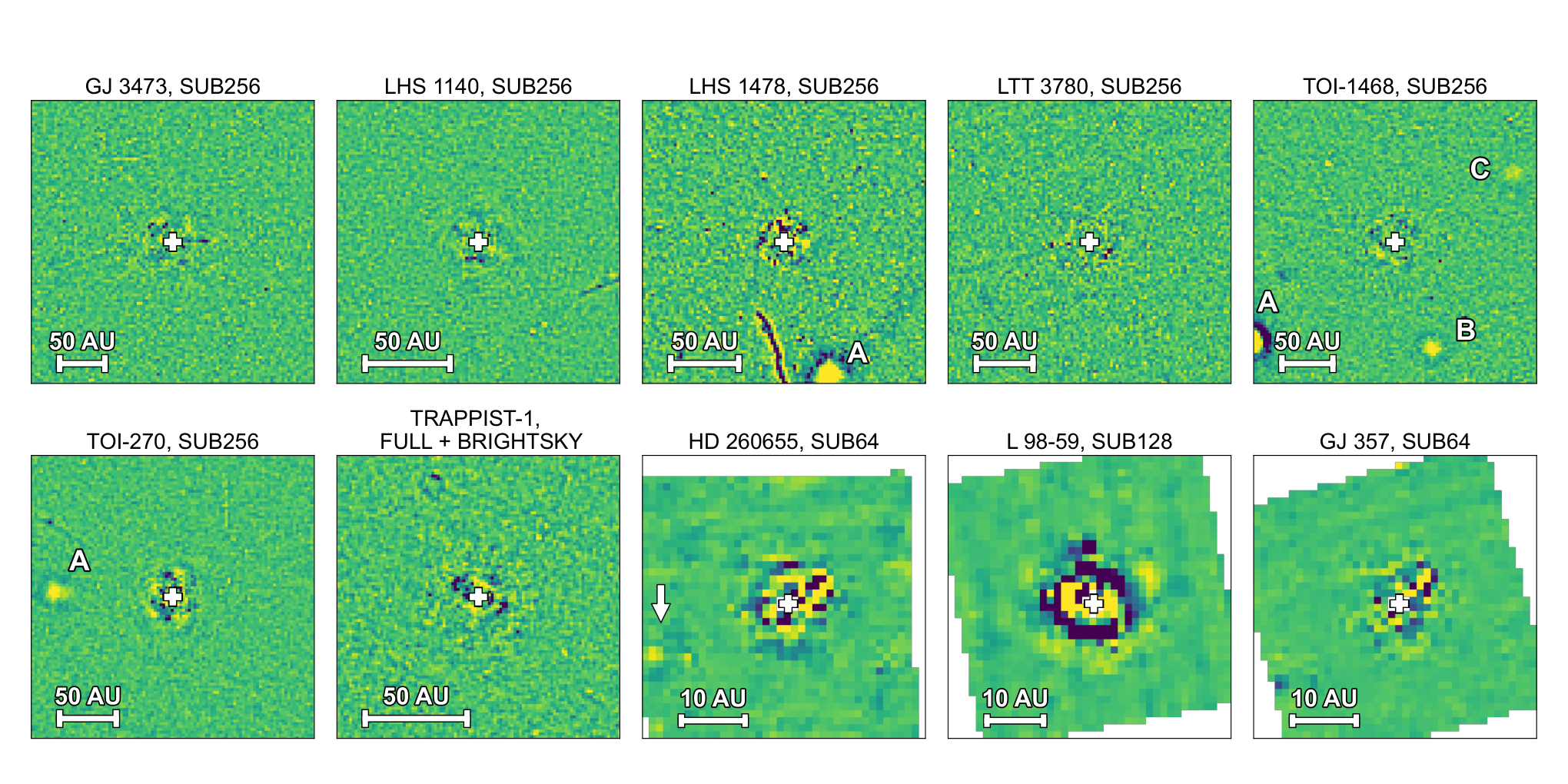
Yihan Li led our search for wide-orbit planets in archival JWST images of ten M-dwarf systems. The observations were taken with MIRI at 15 microns to study known transiting planets. We used the surrounding images to search for colder companions farther from each star.
Transit observations and direct imaging probe different parts of a planetary system. A transit occurs when a planet crosses the star from our viewpoint. Direct imaging searches for the planet’s own light at a separate position. Applying both methods to the same systems can help connect inner planets with distant giants.
Making use of long observing sequences
The study used the target stars as references for one another to model and subtract starlight. It then measured detection sensitivity as a function of separation. This turns a deep image into a quantitative statement about what the search could find.
Subtraction is necessary because a telescope spreads light from a star over many pixels. A faint point beside the star can be a companion, an unrelated source, or a residual from the analysis. Longer exposure time reduces random noise, but it does not automatically remove errors in the starlight model.
A search result is more than a detection
We did not detect wide-orbit companions within 50 AU of the targets. The images contain more distant sources, but those sources are not confirmed planets. Observations at additional epochs can test whether a source moves with the star or lies in the background.
A non-detection does not mean that the system contains no outer planets. It excludes only objects bright enough to appear at the searched positions. A colder or less massive planet could remain unseen. This is why a useful survey reports sensitivity alongside the candidate list.
From brightness limits to planet properties
Converting the measured sensitivity to planet mass requires assumptions about age and atmosphere. The paper identifies limited model coverage for old, low-mass planets as an important uncertainty. The images provide a brightness limit more directly than a mass limit.
Giant planets cool as they age. Two planets with the same mass can therefore have different luminosities, and atmospheric opacity changes how that light is distributed across wavelength. A mass threshold must retain those assumptions. Treating it as a direct measurement would conceal an important part of the interpretation.
What comes next
Archival observations can answer questions beyond the programs that collected them. In this case, an observing sequence aimed at an inner planet also supports a search for outer companions. Each additional system can extend the sample, provided that its sensitivity is measured consistently.
Follow-up images, better age estimates, and atmospheric models for colder planets would strengthen the search. A larger sample could then test how often distant giants accompany compact inner systems. The present work supplies a method and measured limits for that broader comparison.
The paper
Li et al. (2026). A Search for Wide-orbit Planets around M Dwarfs Using Deep MIRI 15 μm Images. The Astronomical Journal.