Research theme 02 · Irradiated worlds
Irradiated brown dwarfs
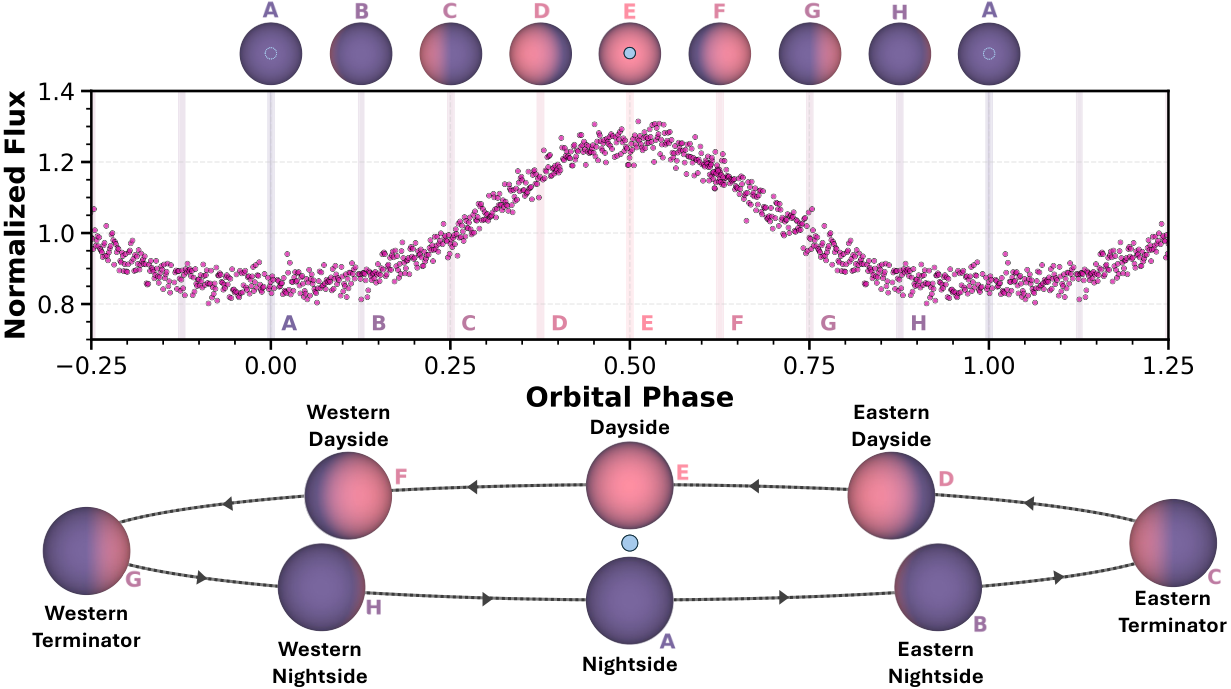
A brown dwarf in a close orbit around a white dwarf can keep one side facing its companion. We compare the heated dayside with the cooler nightside to study atmospheric chemistry and heat transport.
The question
How much heat moves from day to night, and how does external heating change the atmosphere's chemistry?
What we observe
We measure spectra throughout the binary's orbit. As different hemispheres come into view, their changing emission lets us compare the day- and nightside atmospheres.
What we have learned
Broski-Laing et al. (2026) find inefficient day-to-night heat transport on ZTF0038B and an asymmetric nightside carbon dioxide absorption feature. The nightside emission also constrains the system's age. Read the Deep Dive or the preprint on ADS.
Why it matters
These systems let us test how external heating competes with heat from a brown dwarf's interior. Comparisons with giant planets help us understand which atmospheric processes depend on rotation, gravity, and irradiation.
Opportunities for students
Students can measure brightness changes over an orbit, compare molecular absorption across the atmosphere, and test models of temperature and composition.