A permanent day and night
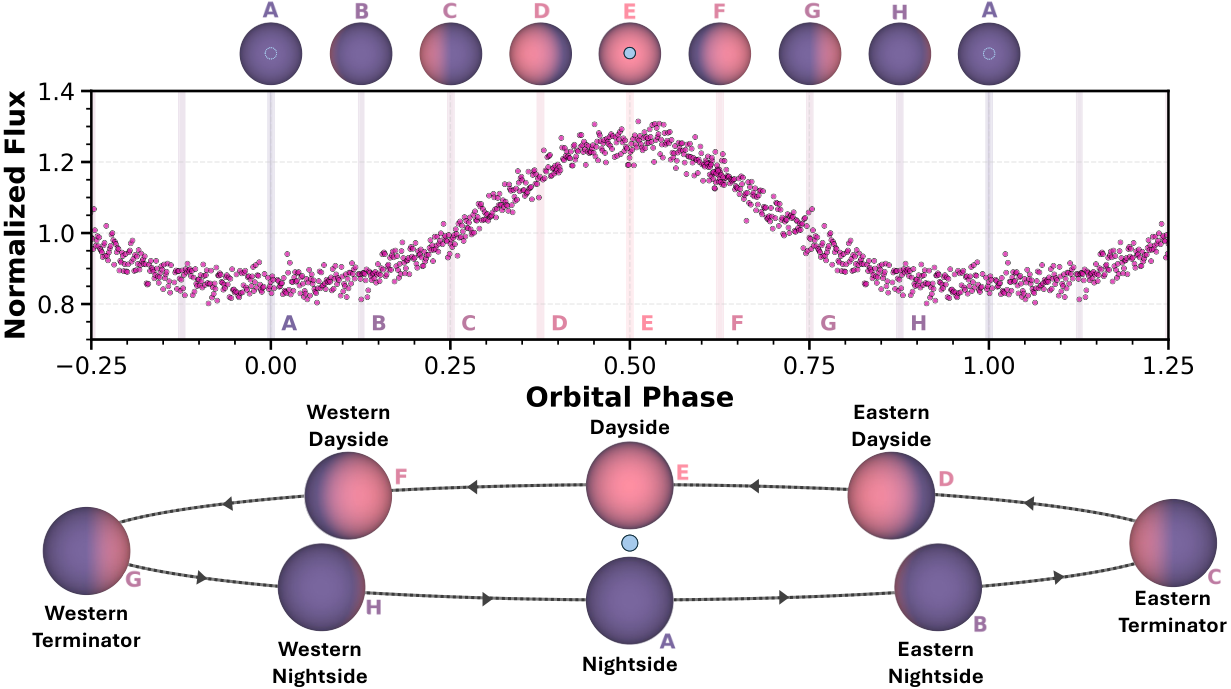
A brown dwarf can have a permanent dayside and nightside. In a close binary, tides can synchronize its rotation with its orbit, so the same hemisphere always faces its companion. The illuminated side receives external heat, while the other side receives little direct light. This geometry lets us test how an atmosphere moves energy from one hemisphere to the other.
ZTF J0038+2030 contains a brown dwarf and a white dwarf, the compact remnant of a star. Daphne Broski-Laing led our study of the brown dwarf, ZTF0038B, with JWST. We followed the system through a full orbit and measured how its spectrum changed as different parts of the atmosphere came into view. The paper reports the first JWST phase curve of a white dwarf–brown dwarf binary.
An eclipse separates the two objects
The eclipse gives us a direct measurement of the brown dwarf’s nightside. When it passes in front of the smaller white dwarf, it blocks the white dwarf completely. During that interval, the observed spectrum comes from the brown dwarf alone.
We compare the eclipse spectrum with measurements immediately before and after the eclipse to recover the white dwarf’s contribution. Subtracting that contribution from the rest of the observation gives us spectra of the brown dwarf throughout its orbit. This separation is essential: a change in the combined light would otherwise be harder to interpret as a change in the brown dwarf’s atmosphere.
JWST’s NIRSpec instrument measures both the overall brightness and molecular absorption across the near infrared. The spectrum covers much of the brown dwarf’s emitted energy. We can therefore estimate the total day- and nightside emission with less reliance on models for unobserved wavelengths.
Little absorbed heat reaches the nightside
Several measurements indicate inefficient heat transport. The atmosphere is brightest when we see its dayside, with no measurable displacement of the brightness peak from the directly illuminated region. The phase curve also has a broad, relatively flat minimum. Its shape suggests that much of the extra heating remains on the dayside.
Our energy-balance analysis constrains the day-to-night heat transport efficiency to less than 10%. The nightside spectrum resembles that of a cool, isolated brown dwarf. Together, these results indicate that internal heat supplies most of the nightside emission.
Inefficient heat transport does not mean that the atmosphere lacks motion. Winds and vertical mixing can move chemical species without erasing the temperature difference between hemispheres. The observations constrain the net energy redistribution, rather than measuring individual wind speeds.
Carbon dioxide presents a separate puzzle
The carbon dioxide absorption near 4.2 micrometers behaves differently from the surrounding spectrum. Its nightside minimum is shifted in orbital phase. We confirm this asymmetry in both the light curve within the absorption band and the absorption depth measured throughout the orbit.
A stronger absorption feature does not necessarily mean more carbon dioxide. The temperature structure and the depth from which light escapes also affect its strength. Our atmospheric fits favor carbon dioxide abundances that are similar across the observed hemispheres, despite the changing feature. We detect an asymmetry, but its physical origin remains unresolved.
The atmosphere also constrains the system’s history
The nightside emission helps us estimate the brown dwarf’s internal luminosity. Comparing that luminosity with cooling models gives a system age of 7.5–8.8 billion years under the adopted evolutionary assumptions. This estimate connects the present atmosphere to an earlier stage when the brown dwarf orbited inside the extended envelope of its evolving companion.
The binary survived that interaction and now has a close orbit. Its inferred age helps constrain how efficiently orbital energy removed the stellar envelope. ZTF0038 therefore connects two parts of our research: the physics of irradiated atmospheres and the evolution of planetary and substellar systems around aging stars. Further phase-curve observations can test which of its atmospheric properties are shared by other white dwarf companions.
The paper
Broski-Laing et al. (2026). Asymmetric Nightside CO2 Features, Inefficient Heat Transport, and Precise Evolutionary Constraints: Spectroscopic Phase Curves Reveal the Past and Present of a White Dwarf–Brown Dwarf Binary. The Astrophysical Journal, 1009, 177.