A spectrum that changes with time
A planet’s spectrum depends on which parts of its atmosphere we see. Clouds, temperature differences, and molecular absorption can vary across its surface. As the planet rotates, these regions contribute different amounts of light. Repeated spectra can therefore tell us more about atmospheric structure than a single observation.
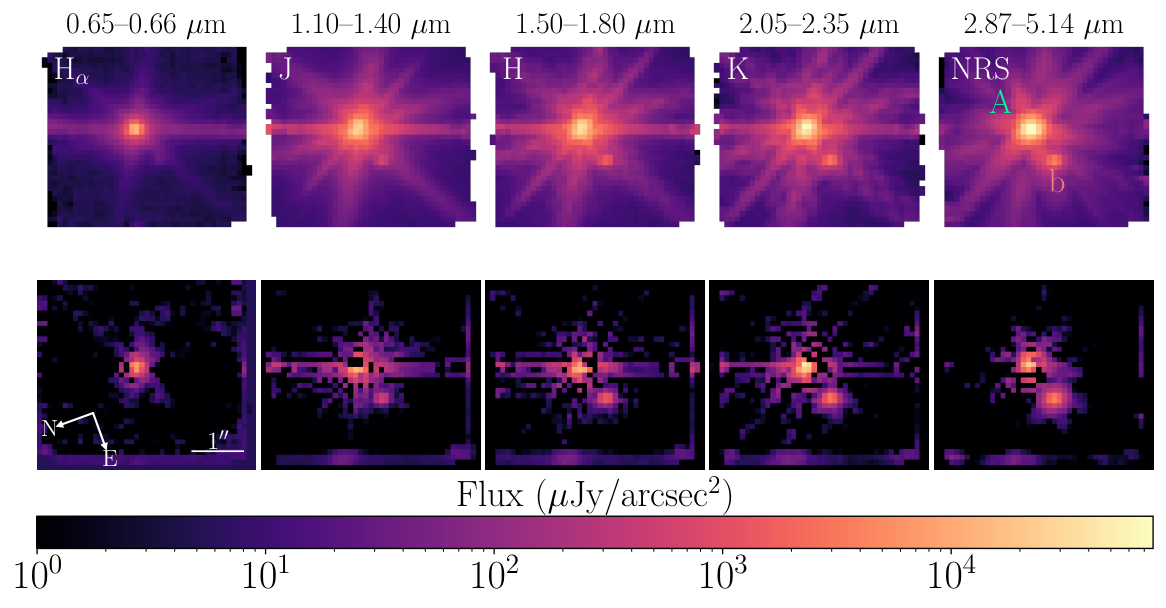
Arthur Adams led our JWST study of 2M1207, a young system containing a brown dwarf, A, and a planetary-mass companion, b. We obtained 20 spectra of each object across a 12.56-hour observation. The study measures how both objects change and tests whether cloud models can reproduce the companion’s wavelength-dependent variability.
Separating the companion from its host
We used NIRSpec’s integral-field unit, which records a spectrum at each position in a small field of view. Both objects fit within the field. This allowed us to measure their spectra during the same observing sequence and follow changes from visible to infrared wavelengths.
Light from the brighter host spreads into the companion’s position. We used observations of a reference object to estimate this pattern and subtract it before extracting the companion’s spectrum. The subtraction must remain reliable throughout the sequence: a small change in the residual host light could otherwise look like variability in the companion.
We tested the remaining contamination by extracting comparison spectra from other positions at a similar distance from the host. These measurements show where the companion’s signal is reliable and where the residual light becomes significant. The shortest wavelengths are particularly difficult because the companion is faint there.
Both members of the system vary
The host and companion show different patterns of variability. Much of the host’s spectrum favors curved trends over a constant or straight-line model. Its hydrogen-alpha emission also changes, and the paper finds a moderate correlation between that signal and the longer-wavelength infrared emission. This motivates further tests of how accretion, the atmosphere, and nearby disk material may be connected.
For 2M1207 b, spectra integrated over two broad wavelength ranges favor a gradual brightening or fading during the observation. Those changes contain information about the atmosphere even though they do not trace a complete repeating cycle.
The observing duration is not a measured rotation period. Most sinusoidal fits to the host imply periods longer than the observing window, and the companion’s broad-band trends do not establish a full cycle. Longer observations are needed to test how the patterns repeat and how they evolve between rotations.
Testing a cloudy atmosphere
We modeled the companion with two atmospheric components containing silicate and iron clouds. Each component contributes a fraction of the observed light. Changing their visible proportions produces a prediction for how the spectrum should vary with wavelength.
This model is broadly consistent with the observed variability amplitudes. It supports an interpretation in which regions with different cloud properties rotate into and out of view. The time series adds a useful constraint because a model must account for both the spectrum and its changes.
The agreement is incomplete at the shortest wavelengths. Additional chemistry could affect that part of the spectrum, but the low signal and residual host contamination limit the interpretation. These data do not establish a unique cloud map or identify a single cause for every spectral change.
What this makes possible
The study demonstrates that JWST can monitor a planetary-mass companion and its host simultaneously. It also shows why measuring a spectrum precisely at one time is only part of the task. We need to understand the stability of the measurement over many exposures and across wavelength.
Longer time series can separate repeating rotation signals from slower changes. Observations at additional wavelengths can test the cloud composition and structure more directly. Together, these measurements can constrain how clouds and temperature vary across young giant planets, while giving us better methods for studying still fainter companions.
The paper
Adams et al. (2025). Characterizing the Time Variability of 2M1207 A + b with JWST NIRSpec/PRISM. The Astronomical Journal.