Watching a planet gain mass
Giant planets grow by collecting gas from the disks around young stars. We call this process accretion. Gas releases energy as it falls toward a planet, and some of that energy emerges as light. Measuring this emission lets us study planet formation while it is still happening.
PDS 70 is one of the clearest places to investigate this process. Two young giant planets, b and c, orbit within a gap in the star’s disk. Both emit light in hydrogen-alpha, a red spectral line that is sensitive to accretion. Their emission gives us a way to ask whether the flow of gas onto a forming planet stays steady or changes over time.
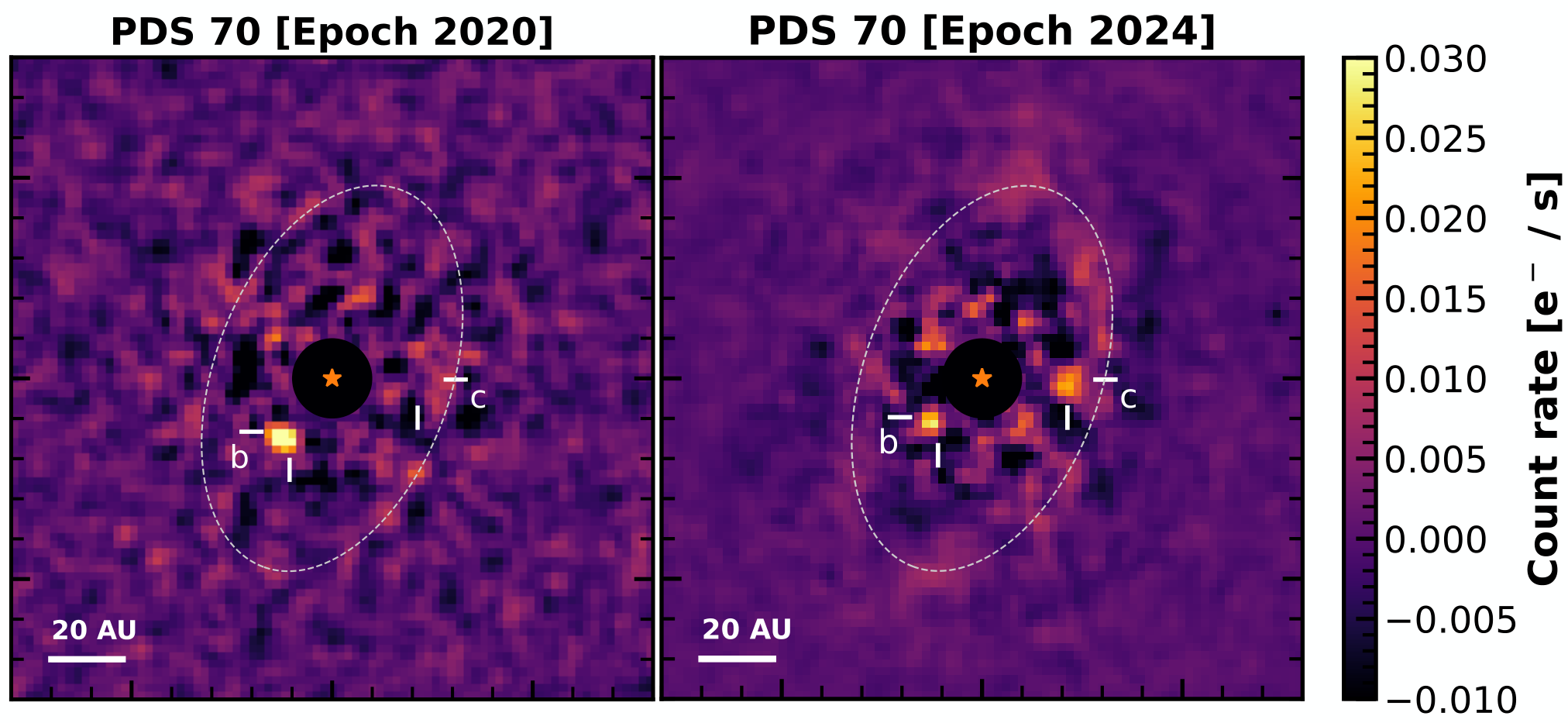
In our 2025 paper, we compared Hubble Space Telescope images from 2020 and 2024. The main result is a significant increase in the hydrogen-alpha brightness of PDS 70 c. The observations constrain how its accretion signature changes and show why the timing of an observation can affect whether we detect a young planet.
Measuring a faint planet beside a bright star
The star is much brighter than either planet. Its light spreads across the image and can obscure the planets even at their known positions. We observed through a narrow filter centered on hydrogen-alpha and used images taken at different telescope orientations, together with reference-star images, to estimate and subtract the stellar light.
Image processing can remove some planetary light as well. A direct comparison of the two displayed images is therefore insufficient to measure variability. We tested how artificial planetary signals passed through the analysis and corrected for the resulting flux loss. These tests also allowed us to check whether a planet as bright as the 2024 detection should have appeared in the earlier data.
PDS 70 c became brighter
We detected PDS 70 c in the 2024 Hubble images. Its measured hydrogen-alpha flux was 2.4 times the 95% upper limit from 2020, with evidence for variability above three sigma. The earlier observation provided an upper limit, so this comparison does not represent a precise ratio between two measured fluxes. It establishes that c was significantly fainter in 2020.
The result survives our injection-and-recovery tests. The paper also finds that the brightening is consistent with the trend in independent ground-based observations. Together, these checks support a real change in the planet’s emission.
What changed in the accretion flow?
The hydrogen-alpha variation suggests that accretion onto PDS 70 c is variable. Changes in the gas supply or in the flow between a disk around the planet and the planet’s surface could change the emitted light. Dust along our line of sight could also change how much emission reaches us.
Hydrogen-alpha alone does not determine the mass accretion rate uniquely. Different models relate line brightness to the energy released by accretion in different ways. Simultaneous ultraviolet, optical, and infrared observations would help distinguish changes in the gas flow from changes in dust obscuration. They would also test how reliably hydrogen-alpha measures planetary growth.
Why repeated observations matter
A planet can fall below an imaging survey’s detection limit when its accretion emission weakens. A non-detection at one time does not establish that no growing planet is present. Repeated observations can measure how often a planet is bright enough to detect and improve estimates of how common forming planets are.
Variability alone does not explain the scarcity of systems like PDS 70. Our paper tests that possibility and finds that other properties of the planets or their disks must also matter. Continued monitoring can determine the duration and frequency of bright episodes. That is the next step toward connecting the emission we observe today with the history of a planet’s growth.
The paper
Zhou et al. (2025). Evidence for Variable Accretion onto PDS 70 c and Implications for Protoplanet Detections. The Astrophysical Journal Letters.